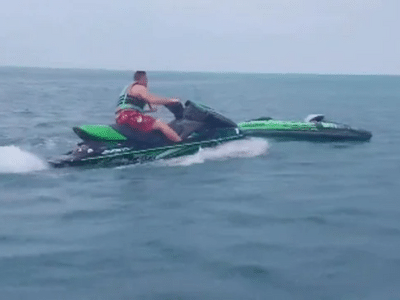
A family day at turned into a terrifying fight against wind and open water when a 6-year-old boy was swept hundreds of yards from shore on an inflatable raft. With the child eventually jumping into the lake in panic, a father-and-son pair on jet skis spotted him at the critical moment and raced toward him. The dramatic rescue unfolded near Porter Beach in northwest Indiana in May 2025. The boy had been standing in knee-deep water under supervision when he unexpectedly climbed onto the inflatable. Strong offshore winds quickly carried the raft away from the beach.
Inflatable raft disappears into open water
Tom Peeler and his son, Tommy, had taken their jet skis out on Lake Michigan for the first time that spring when they noticed what appeared to be an inflatable object far offshore. Tom estimated it was roughly 300 to 400 yards from the beach. What initially looked like an ordinary inflatable quickly became an emergency when the pair realised a child was involved.
Tommy raced toward the raft. As he approached, he could see the boy struggling in the water. “Probably about 80 feet from the raft, I saw just a head and a little hand sticking up, and I raced over there,” Tommy told CBS Chicago. The boy had apparently jumped into Lake Michigan after becoming frightened as the inflatable was carried away. The Peelers reached him and pulled him to safety. They also helped two adults who had attempted to swim toward the stranded inflatable.
Why lake winds can turn dangerous so quickly
The rescue highlighted a hazard that can be easy to underestimate: offshore winds. According to the , an offshore wind blows from land toward open water. While the shoreline may look relatively calm, the wind can become considerably stronger farther from shore. Inflatables can act almost like sails, allowing wind to carry them rapidly into deeper water.
The organisation has repeatedly warned against using inflatable toys on the Great Lakes in such conditions. Its guidance says that if an inflatable is blown away without anyone on it, people should let it go rather than swim after it. If someone is already aboard, they should hold on and signal for help. Dave Benjamin, co-founder of the Great Lakes Surf Rescue Project, told CBS Chicago that a young, inexperienced swimmer can have only seconds or minutes in a drowning emergency. “With a drowning, you know, you're seconds to minutes for a successful rescue if you have a young child that is not a swimmer,” Benjamin said.
A warning backed by other lake rescues
The incident was not an isolated example. In July 2023, the rescued two children who had drifted about one nautical mile offshore on inflatable rafts near Platte River Point in Michigan. crews reportedly battled 6- to 7-foot seas before bringing the children safely back to shore.
A similar incident occurred in Michigan City in 2019, when a toddler on an inflatable duck was carried away from shore by wind. The child eventually fell into the water but was rescued by people nearby. Officials stressed that water wings were not a substitute for a Coast Guard-approved life jacket. The National Weather Service also warns that Great Lakes beaches can develop dangerous currents, including rip currents that pull swimmers away from shore.
The rescue ends with a simple message
For the 6-year-old near Porter Beach, the timing of the Peelers' arrival proved crucial. What began as a routine outing on the lake became a rescue that unfolded hundreds of yards from shore. Tom Peeler said he felt there was a reason they happened to be in the right place at the right time. His son offered a simpler message after the child was brought to safety: “I'm just glad the boy's alright.”
The episode is a reminder that on the Great Lakes, a seemingly harmless inflatable can become dangerous remarkably quickly. Wind direction, waves and currents can change the situation in moments, making awareness—and knowing when not to chase an inflatable—just as important as knowing how to swim.
Contact to : xlf550402@gmail.com
Copyright © boyuanhulian 2020 - 2023. All Right Reserved.