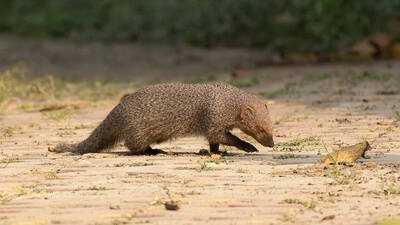
Buck Island Reef National Monument includes the 176-acre uninhabited Buck Island off the northeast coast of St. Croix in the U.S. Virgin Islands. It is best known for its coral reef, but it is also now a stronghold for one of the world's rarest lizards, the St. Croix ground lizard . Over roughly 20 years, the park worked to remove rats, mongooses, and exotic plants, making the island safe enough for 57 lizards to be moved there from Green Cay . The Park Service has informally estimated that more than 10,000 lizards live on the island today, although peer‑reviewed studies and Fish and Wildlife Service assessments report considerably lower numbers. The St. Croix ground lizard no longer lives on the main island of St. Croix, where it disappeared in the late 1960s, mainly because of agricultural habitat change and predation by small Indian mongooses, the U.S. Fish and Wildlife Service reports.
Two decades of removing rats, mongooses and exotic plants ahead of the 2008 move
The National Park Service credits the lizards' success to roughly 20 years of work, ending with the 2008 move, to eliminate nonnative predators and exotic plants. Management reports show that roof rats were eradicated from Buck Island using diphacinone baits. Some literature suggests that this was followed by an increase in the population of house mice. The relocation itself was meant as insurance. As the Park Service wrote in an environmental assessment, the goal was to minimize the risk that fire, flood, hurricanes, tsunamis, or non-native predators could wipe out the lizard populations. To move from endangered to threatened status, the recovery plan requires a self-sustaining population of 500 lizards on Buck Island.
57 lizards from Green Cay, 32 females and 25 males, moved in 2008 (NPS cites 2007)
The five-year review carried out by the U.S. Fish and Wildlife Service and several scientific articles show that the translocation occurred between late April and early May 2008, whereas the Park Service records it as 2007. The founder group comprised 57 adults, including 32 females and 25 males, taken from Green Cay National Wildlife Refuge. Early results were encouraging. The report indicates that the introduced lizards behaved normally and mated, and that eggs laid by gravid females hatched within two months of the release. Gravid females and juveniles that had not been marked during earlier visits were captured later, showing that the lizards had reproduced on the island within a year.
1,473 lizards by 2013, a 26-fold increase, in the Angeli 2018 study
A by Nicole Angeli and colleagues, including National Park Service staff on Buck Island, put numbers on the recovery. Based on surveys and population modeling, the study estimated about 1,473 lizards on the island in 2013, five years after translocation. The paper tracked the Buck Island population through a series of mark-and-recapture studies and geographic surveys, finding that the population was not only growing but also spreading, with lizards leaving the release area for new territory. A separate 2018 study in Biological Invasions put the pace at 5 to 10 percent growth every six months and projected that the population could grow roughly fivefold before filling all suitable habitat.  St. Croix ground lizards showed a population increase and a habitat expansion by 5-10 percent every six months since their translocation to Buck Island, as seen in a 2018 publication in Biological Invasions indexed in PubMed. The population was projected to grow fivefold before colonizing all suitable habitats.
More than 2,000 lizards on Buck Island by 2020, against the Park Service figure of more than 10,000
A estimated about 3,000 St. Croix ground lizards across the four islands where they live, with more than 2,000 on Buck Island. The Park Service's estimate of more than 10,000 is higher than both the Oryx figure and the 2025 Fish and Wildlife Service status review, which puts the total for all four populations at about 2,000, most of them on Buck Island. The Park Service article of June 2020, which appears to be the source of the 10,000 figure, does not explain how that number was calculated. The Oryx authors used a priority-setting method that combined habitat suitability with the presence of, and options for controlling, mongooses to rank candidate reintroduction sites on St. Croix. They found that current land cover would allow extensive range expansion, an increase of 180%, but noted that large-scale mongoose eradication is perhaps unrealistic on a populated island. It is safest to say that the number of these lizards has grown from 57 to more than 2,000.
February 2022, 26 lizards moved from Buck Island back to the main island of St. Croix.
Buck Island has since become a source for new populations. In February 2022, 26 lizards from Buck Island were relocated to St. Croix, 13 each to the Sandy Point National Wildlife Refuge and the University of the Virgin Islands Wetlands Reserve. Their long-term viability remains uncertain, the Fish and Wildlife Service says, while the Oryx study found that the Buck Island population can support such releases with little risk to the source population. The lizard is still endangered, and all four of its populations face threats from hurricanes, invasions by new species, and other events.
Contact to : xlf550402@gmail.com
Copyright © boyuanhulian 2020 - 2023. All Right Reserved.