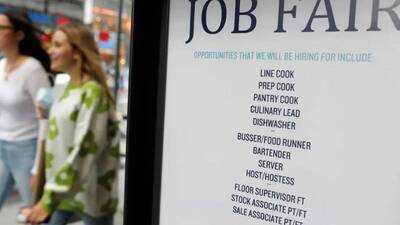
As layoffs continue to be minimal and the majority of American workers have job security, the number of people asking for US unemployment benefits fell last week to the lowest level since mid-July.
According to the AP, initial jobless claims decreased to 197,000 from a revised 198,000 the previous week, according to the Labor Department on Thursday. Weekly volatility is mitigated by the four-week average of claims, which decreased by 2,500 to 200,000.
Claims for jobless benefits are a barometer for layoffs, and economists watch them because they can be an indicator of where the job market is moving. Throughout the year, they've consistently been under 220,000, a series of record lows.
Since the conflict with Iran started on February 28, rising oil costs have put pressure on consumers and companies, but the US labor market has remained strong.
US employers posted less job opening in August reported by US on Tuesday. The number of layoffs and people quitting their jobs fell down, which is a clear indication of confidence in their prospects, retreated slightly in the month of August. according to the The Labor Department’s Job Openings and Labor Turnover Survey (JOLTS). Before deducting employees who left or lost their employment, the JOLTS report 's estimate of gross hiring increased somewhat in August but is still at low levels.
The senior US economist at oxford Economics, Matthew Martin, "jobless claims continue to defy expectations and remain extremely low, dovetailing with the JOLTS reports' layoff rate, which shows that while businesses aren't hiring at a rapid pace, they are reluctant to let their current crop of workers go."
Companies are restricting to fire the employees as they remember the shortage of employees even by the end of lockdown period during pandemics. In order to avoid that shortage, there are few layoffs. They are hiring people but marginally by the standards of previous years.
Employers, including businesses, governmental organizations, and NGOs, have added 80,000 jobs on average each month so far this year, with an unexpected 162,000 in August.
That's an improvement over a dismal 2025, when hiring was hindered by high interest rates and President Donald Trump's ambiguous trade policies, resulting in an average monthly job creation of 9,700.
Next week, the labor department will publish the September jobs data. According to a study of forecasts conducted by the data firm FactSet, it is anticipated that businesses added 90,000 jobs and that the unemployment rate stayed low at 4.1%.
Hiring is still much behind the 491,000 jobs generated per month during the 2021–2022 hiring boom that followed COVID-19 lockdowns and the 166,000 jobs created on average per month in 2023 and 2024.
Contact to : xlf550402@gmail.com
Copyright © boyuanhulian 2020 - 2023. All Right Reserved.