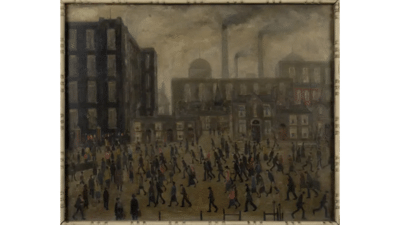
A British newspaper editor bought an LS Lowry painting for just £10 in 1926 and kept it in his family for almost a century. Now, 99 years later, the early industrial scene has sold at auction for £805,200, including the buyer’s premium, after remaining in the same family’s collection throughout that period, The Guardian reported.
The painting, Going to the Mill, was sold at Mall Galleries in central London on Friday, 2 May last year. Created in 1925, it was purchased directly from Lowry by Arthur Wallace, then literary editor of the Manchester Guardian. Although the work was marked at £30 on the back, the artist agreed to let Wallace have it for £10.
How Lowry sold the painting for £10Wallace’s grandson, Keith, recalled how his grandfather acquired the work. According to him, Lowry proposed the lower price, after which Wallace wrote a cheque. The artist then offered him another painting.
“Lowry said with great daring: ‘Could we say £10?’ and Grandpa wrote a cheque. Then Lowry wrote back to him saying: ‘I think I’ve charged you too much. Can I give you another one as well?’ So Grandpa got two Lowrys for £10,” Keith said.
The second work, The Manufacturing Town, also went to the Wallace family. However, the family sold it several years ago, while Going to the Mill remained in its collection for nearly 100 years.
Before its auction, Going to the Mill had been on long-term loan to Pallant House Gallery in Chichester.
Auctioneer praises rare early Lowry paintingSimon Hucker, a modern and contemporary art specialist at the auction house Lyon & Turnbull, welcomed the result, highlighting the painting’s early date and the length of time it had remained in a single collection.
“We’re absolutely delighted by the price achieved for this exceptional, early painting by Lowry, bought from him when he was a virtual unknown,” Hucker said.
“There are few artists who become a household name in Britain and Lowry definitely falls into this category.”
Hucker also described Going to the Mill as an example of Lowry’s distinctive approach to depicting industrial life. Rather than treating his figures as simple details within a scene, the artist used them to convey ideas about the experience of living in a crowded city.
“Going to the Mill is the epitome of a 1920s Lowry, the period when he becomes a unique voice in British art,” Hucker said.
He added that it was particularly rare for a painting of this kind to have remained in one collection for almost a century.
Lowry’s depictions of industrial BritainLowry became known for paintings of industrial communities in north-west England, including scenes featuring factories, mills, terraced streets, chimneys and crowds moving through urban spaces.
His work often captured the contrast between the energy of industrial cities and the loneliness of the people who lived and worked in them. Although he is widely associated with his depictions of workers and urban crowds, his output also included portraits, seascapes, landscapes and imaginative works.
His recognition grew over time. Lowry received limited public attention early in his career, with his first solo exhibition in London taking place in 1939. He later became one of Britain’s best-known artists, and an arts centre in Salford was named after him.
Previous saleThe £805,200 sale of Going to the Mill adds to the strong auction results achieved by Lowry’s work. In 2024, his painting Sunday Afternoon sold for almost £6.3 million at auction.
Contact to : xlf550402@gmail.com
Copyright © boyuanhulian 2020 - 2023. All Right Reserved.