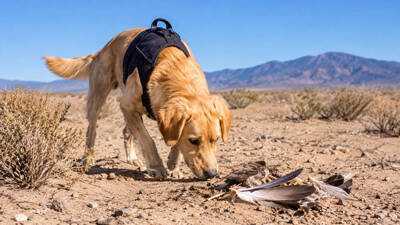
Bird counting is harder in the open desert than it may seem. Wildlife managers rely on bird mortality counts to determine the impact of human activity on birds and a count can only be as accurate as the person doing it. A new study has put that to the test by pitting human surveyors directly against a conservation detection dog. The record of the paper lays out how the two compared. The paper describes paired searches in desert habitat, with each surveyor type working the same carcass placements so the team could compare detection under identical conditions. It also reports that detectability varied sharply with carcass size and ground cover, with larger birds and sparser substrate giving both humans and the dog their best odds.
Two years of trials in the desert of Southern New Mexico
The study, Carcass size and ground substrate drive detection rates of avian carcasses by human surveyors and a dog team, was led by Kelley C. Boland and published in 2026 in . Co-authors of this paper are: Abigail Jean Lawson, Dylan M. Osterhaus, Patricia L. Culter, Gregory A. Davidson and Martha J. Desmond. In the study, the authors analysed carcass-search data from wind-energy surveys in southern New Mexico and tested whether detection changed with carcass size, substrate and weather. They found that both humans and the dog were strongly helped by larger carcasses and less visually complex ground cover and they note that the same field factors influenced survey performance more than the choice of search alone. The research was conducted in the semi-arid high desert of southern New Mexico for two years using detection trials. According to the USGS record of the paper, 27 human surveyors and one conservation detection dog took part in 1,096 trials with 238 carcasses representing 50 bird species.
The dog found 87% of carcasses; people found 49%
According to the paper’s abstract on the USGS website, the dog had an average detection rate of 87%, compared with 49% for human participants, a difference of 38 percentage points. There was quite a variation among individual humans: humans' detection rates were between 25% and 71%. 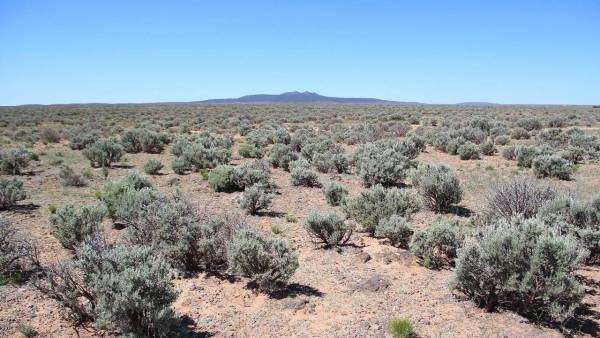 Even the best human searcher, at 71%, still fell below the dog’s 87% average. The dog also missed 13% of carcasses, a reminder that detection dogs improve carcass recovery but cannot guarantee every dead bird is found. The authors point out that the extent of the difference is similar to the results obtained previously by other researchers.
Carcass size and ground substrate affected both searchers
The title specifies the two variations that impacted the outcomes. Detection for both humans and the dog depended on carcass size and ground substrate. The chances were greater when dealing with large carcasses and less complicated surfaces. The study adds an important caveat: detection depends on carcass size and ground substrate.
Why the number matters for conservation
As the abstract provided by the USGS notes, correct estimation of bird mortalities is necessary to understand human impact on birds and to develop effective conservation efforts. However, if carcass surveys fail to account for a significant number of carcasses, mortality estimates will fall short of the actual figures. In addition, the research is described as being insightful in relation to wildlife mortality estimates.
Contact to : xlf550402@gmail.com
Copyright © boyuanhulian 2020 - 2023. All Right Reserved.