
Diwali is nearly here. So is the annual ritual of sprucing up homes, clearing out clutter and making room for new purchases and fresh beginnings.
However, the festive clean-up need not stop at one’s home. Investment portfolios, too, deserve a periodic review to restore balance in asset allocation, shed deadweight and make better financial choices.
Take the case of Navi Mumbai-based engineer Vaibhav Wandre. When he reviewed his portfolio recently, he realised that some of his life insurance-cum-investment policies were yielding annual returns of just 5-6%. “I was paying a combined annual premium of Rs.1.2 lakh for policies that did not even provide adequate life insurance cover. I surrendered them and used the proceeds of Rs.3 lakh to prepay my top-up home loan,” he says.
The 42-year-old also directed the money freed up towards equity mutual funds through systematic investment plans (SIPs). “I expect these schemes to fetch relatively higher returns,” he adds.
Mumbai-based software engineer Tanushri Bhatkar, 37, has a similar story. “As part of my annual portfolio review, I discovered that my portfolio had a couple of poor-performing flexi-cap schemes, yielding returns of around 6%. I redeemed the funds and used the proceeds to prepay my home loan,” she recollects.
A thorough portfolio review can, thus, be rewarding: it can uncover low-yielding investments and give you an opportunity to correct past mistakes.  Identify, liquidate and redirect
Buying insurance-cum-investment policies with long lock-in periods without assessing their suitability is a common mistake investors make early in their careers.
Many end up buying endowment plans simply because the agent is an elderly acquaintance or a neighbour, rather than doing it because the product meets their financial needs. Your clean-up can begin with a review of your insurance portfolio.
For individuals with dependants, that is, those who rely on the policyholder’s income for their requirements, adequate term insurance is essential. “It should be the foundation of your protection portfolio,” says Preeti Zende, Founder, ApnaDhan Financial Services.
ALSO READ |
As a rule of thumb, the sum assured should be at least 10-15 times your annual income—though the ideal amount will depend on your family’s needs, financial goals, your spouse’s income, and your assets and liabilities, among other factors. Personal health insurance is also critical, even if you are young, have no dependants and are covered under your employer’s group policy, given rising healthcare costs.
Endowment and money-back plans, meanwhile, deserve close scrutiny. “These typically give returns of around 4-6%, and the cover is small. Before surrendering one, check the surrender value, how many premiums are left, and any bonuses you would forfeit. Never surrender blindly and never do so before a term cover is in place,” says Nisreen Mamaji, Founder of MoneyWorks Financial Services.
Check bloated portfolios
Many investors start SIPs in mutual fund schemes based on recent performance, but lack the patience to ride out periods of volatility. “If a scheme fares poorly in the interim, they stop the SIP and start another in a different scheme from the same fund category,” explains Pankaj Mathpal, Founder of Optima Money Managers.
However, they often retain existing investments due to exit loads or potential tax implications of redemption. Over time, this can result in multiple schemes within the same category, creating unnecessary duplication and portfolio clutter, cautions Mathpal. Diwali is an opportune time to embark on a clean-up drive. “If certain funds have consistently underperformed their relevant benchmarks and peers, investigate the reasons rather than switching immediately,” he adds.
Any switch should also take exit loads and short- and long-term capital gains tax into account. Mamaji says, “Judge a fund against its benchmark and category peers over three-to-five years, not against the last quarter. Check for style drift, a change of fund manager, promoter changes, etc. Sell only on genuine underperformance, not on the basis of a bad year.” 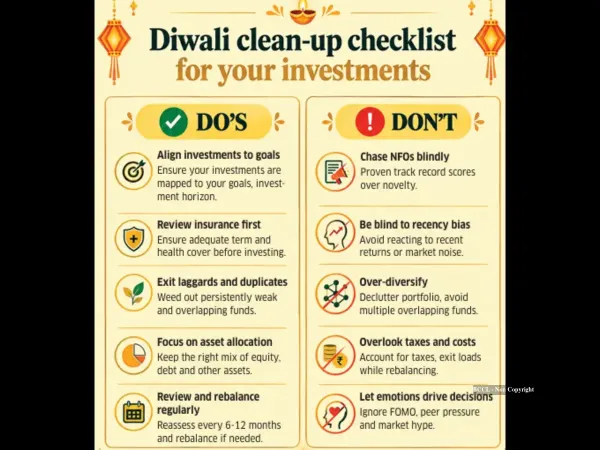
Trend-chasing can hurt portfolios
Financial planners say the rush to own a piece of the latest new fund offer (NFO) is a common pattern. “An NFO feels special because it’s new and priced at `10. But it isn’t cheap. It only means you’re buying fewer, smaller units. Most NFOs launch in categories where several established funds with proven track records already exist,” according to Mamaji.
ALSO READ |
Investors may end up investing in schemes similar to those already in their portfolios. “At the heart of these decisions are often FOMO (fear of missing out) and the desire to earn higher returns. Investors fear missing out on the latest investment theme or a newly launched fund being promoted as a must-have for their portfolio,” says Zende. The result? An unwieldy portfolio with multiple schemes serving similar purposes. “Such investments offer limited, meaningful diversification and greater complexity in monitoring. They can also lead to unsuitable risk exposure, unnecessary transaction costs and avoidable tax outgo,” she adds.
A portfolio rejig should identify overlapping schemes and funds that have consistently underperformed. “Review each fund against your financial goals, investment horizon and risk profile,” notes Zende.
Over-diversification can backfire
Diversification across asset classes and mutual fund categories is essential for managing risk, but spreading investments too thin serves no purpose.
“Investors tend to buy funds from every AMC (asset management company) or invest in multiple NFOs, believing that more funds automatically mean better diversification. In reality, many schemes have overlapping stock holdings, resulting in unnecessary duplication,” says Mayank Gosar, CEO of financial advisory firm Softcon Capital.
Multiple funds with similar exposure do not meaningfully boost returns or reduce risk. “For instance, a well-chosen flexi-cap fund can invest across multiple sectors, reducing the need to purchase a separate sectoral fund for every investment theme,” explains Gosar, also a chartered accountant. He recommends holding five-to-seven funds in a portfolio, provided each scheme serves a distinct purpose.
Buying on recency bias
Many investors rank mutual funds and asset classes by returns over the past six months to one year, and keep adding schemes to their portfolios.
“One of the biggest mistakes investors make is chasing past performance and buying mutual funds simply because they were the top performers of the previous year,” says Gosar.
This recency bias often results in an unbalanced portfolio, with an asset allocation that may not align with the investor’s goals or risk appetite. “Most investors start their investment journey with the right intention, but tend to get derailed along the way because of behavioural biases. A well-structured portfolio requires discipline, appropriate asset allocation and periodic reviews rather than constantly chasing the latest outperforming scheme,” points out Mathpal.
Mamaji observes that investors are often swayed by recommendations from friends or relatives, ‘top five’ fund lists or ‘star fund’ headlines. “However, portfolios should start with asset allocation—equity, debt and gold, and how much to allocate to each—and only then move to fund selection,” she says.
Many investors fail to define their risk profile, investment horizon and goals. Mamaji adds, “As a result, a short-term goal may be invested in a small-cap fund, or a retiree may hold a portfolio with 90% equity exposure.”
Map investments to goals
Take into account your age, investment horizon and risk profile before devising an asset allocation plan.
Consider a 35-year-old male with a financially independent spouse and two children aged two and four. His goals include retirement in 20 years and funding his children’s higher education in 14-16 years.
“Such an individual can consider allocating 25% of his portfolio to flexi cap and multi-cap funds to provide diversified equity exposure across market capitalisation,” says Gosar.
Multi-asset funds can account for another 25%, with balanced advantage or other hybrid funds making up a further 25%. According to Gosar, “He can also consider investing 15% in debt funds for stability and liquidity, while 10% can be allocated to mid cap and small-cap funds for higher growth potential.”
However, this is not a universal recommendation as every investor’s profile is unique. Devise your investment plan only after ascertaining your existing investments, risk appetite, goals and income stability, among other factors.
Financial plans must evolve with changing personal circumstances and market conditions. As a goal approaches, gradually shift investments from equity to debt to reduce exposure to market volatility. Finally, review your portfolio every six months to a year to ensure your investments remain on track to meet your financial goals.
Contact to : xlf550402@gmail.com
Copyright © boyuanhulian 2020 - 2023. All Right Reserved.