
With Diwali festivities peaking and the wedding season starting by month-end, the recent correction in gold prices may have come as a welcome opportunity for households considering traditional purchases. The 19.2% dip—from Rs.1.75 lakh per 10 gram peak on 29 January 2026 to Rs.1.41 lakh on 29 October (MCX Spot price, Bloomberg)—is significant because not only does it signal a reversal after a strong rally, but also because gold’s credentials as a safe-haven asset are being tested.
“It has moved from being a conservative asset class to a volatile one because that’s how it has behaved in the past 3-4 years. The world has become unpredictable, where asset classes are being driven more by geopolitical factors, fear and greed, rather than their fundamentals and technicals,” says Kalpesh Asher, Founder, Full Circle Financial Planners and Advisors.
Currently, gold prices are being driven by a combination of factors, including monetary policy, real yields, geopolitical uncertainty, and investment demand. “The elevated United States inflation and changing US Federal Reserve rate expectations are keeping Treasury yields high and cre ating volatility in bullion, but central bank purchases, strong exchange-traded fund (ETF) flows, Chinese investment demand, and concerns around rising US debt continue to provide structural support,” says Manav Modi, Commodities Analyst, .
While the price uncertainty may persist, most experts believe the upswing is likely to continue in the short term. Should you make the most of the dips and buy gold for personal use or invest more this festive season? 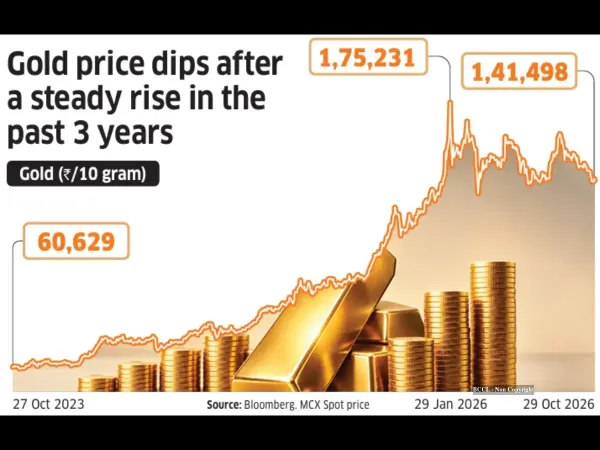 Outlook for gold
“The demand for gold has remained constructive in 2026 and this trend is likely to continue over the next 6-12 months,” says Vijay Kuppa, CEO, InCred Money. The demand for gold in the first half of 2026 rose by about 2% from the corresponding period a year ago, to 2,522 tonnes with a record value of $380 billion, according to the World Gold Council data.
Agrees Mahendra Luniya, Chairman, Vighnaharta Gold. “Gold prices could remain in the Rs.2-2.25 lakh range over the next 6-12 months because the current uncertainty is likely to increase. The US debt may continue to increase and the dollar is expected to remain strong up to a certain level. Beyond that point, political issues will have a greater influence on gold prices, which could lead to a further price rise,” he says.
ALSO READ |
However, some choppiness cannot be ruled out depending on factors such as the US Fed rate hikes and geopolitical risks. “The Fed resumed rate hikes in September, US bond yields are near their highest in about two decades, and the dollar has strengthened. That’s what pulled gold down from its peak. If the Fed continues to increase rates, gold could correct further,” he says.
Should you buy now?
“Prior to 2023, the question was not whether to buy during the festive season or not, but in what form and how much to buy,” says Asher. “Indians still want to buy gold on festive occasions, but are more cautious and have an eye on the prices, instead of splurging blindly,” he adds.
Timing the market may not be the ideal way to decide gold purchase because it would depend on several factors, including your existing portfolio, financial goals and whether it’s for personal use or an investment. “Rather than making purchase decisions solely around short-term market movements, consumers should consider their financial objectives, planned expenditure and the purpose for which they intend to own gold,” says Samit Guha, Managing Director & CEO, MMTC-PAMP.
For those focused on investment rather than traditional purchase, it may be to allocate small amounts regularly through a systematic approach. “Investors should start to accumulate gold as there is no right bottom for any price. Since more volatility is warranted, a staggered approach is advised, with purchase recom mended at dips,” says Modi.
Kuppa agrees. “Gold is neither clearly overvalued, nor a bargain. It’s fairly priced if the US rates stop rising, and expensive if they don’t. That’s a bet on the Fed, which is why we suggest buying in stages and treating gold as a diversifier, not a trade,” says Kuppa.
Luniya, however, is more confident. “The current prices are attractive, and for those who want to remain invested for 2-5 years, they present a very good opportunity to invest and expect good returns,” he says. Still, he recommends consulting a financial adviser and your portfolio needs before making a decision.
Before buying, consider the pros & cons of various types of gold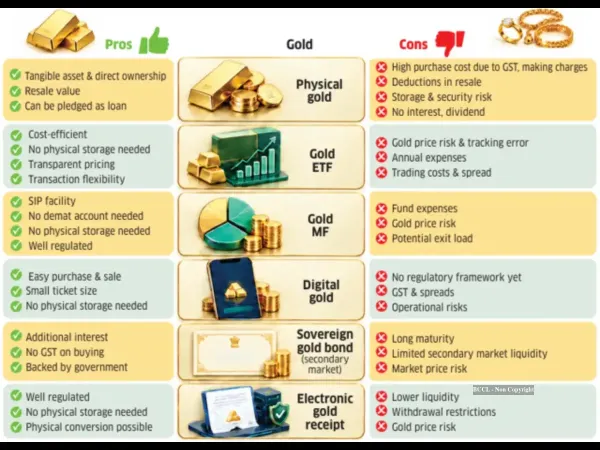 Consider these features to assess suitability
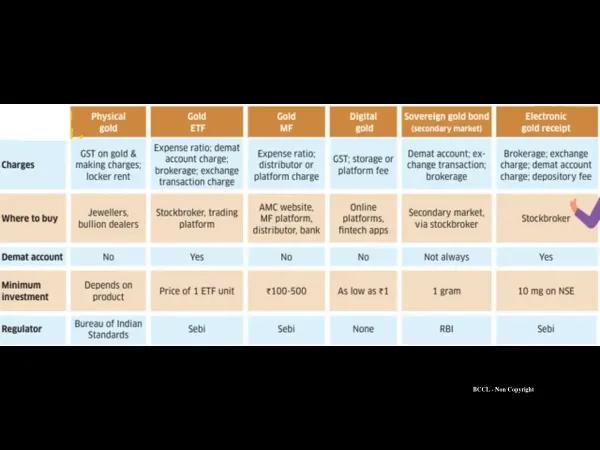 In what form should you buy?
The choice of gold ownership—physical, ETFs, mutual funds, digital, sovereign gold bonds, electronic gold receipts—depends on the consumer’s objective, preferred mode of access, and intended use. “Each format serves a different requirement, and consumers should understand the associated costs, liquidity arrangements, custody mechanisms, and applicable regulatory framework before deciding,” says Guha.
Most experts believe gold ETFs are the best choice if you want to buy gold as an investment. “With gold ETFs, you are free from the responsibility of physically storing and safeguarding gold. When gold prices rise, ETF prices also rise, allowing you to benefit from the hike,” says Luniya.
It may also be the default choice currently for those wanting to start investing in a systematic manner since investment in gold fund of funds (FoFs) has been temporarily restricted by the Securities and Exchange Board of India (Sebi). “While no official reason has been conveyed, the market believes the move aims to rein in gold imports and, in turn, India’s import bill,” says Kuppa.
ALSO READ |
“The curbs may temporarily affect fresh lump-sum investments, new systematic investment plan (SIP) registrations, and switch-in transactions for investors seeking gold exposure through mutual funds, without impacting the existing investments,” says Luniya. While gold ETFs offer market-linked exposure through a demat account, gold FoFs provide an indirect route through a mutual fund structure without requiring investors to hold a demat account.
You could buy jewellery for personal use, “but don’t count on it as a low-cost investment. Making charges and resale deductions can eat into a large part of the gain” says Kuppa.
Though digital gold is gaining popularity due to easy access and small ticket size, remember that it carries high risk since it does not fall within the regulatory framework yet (though regulations are expected soon), and you could be left with no recourse to redressal in case of a dispute.
How much should you allocate?
Allocation to gold depends on a household’s financial goals, existing assets, liquidity needs and investment profile. Historically, experts have advised a 5-10% allocation to gold, but most are now suggesting a slight increase. “Given the current uncertainty, keep the allocation around 15%, not as a thumb rule, but as a moderate estimation,” says Asher.
“It’s also important to distinguish between gold held for personal use and specifically as an investment. Consumers should evaluate their overall financial position before determining how much additional gold they wish to acquire,” says Guha.
Gold is meant to steady an investment portfolio, not drive its growth. Hence, a common starting point is 5-15% of your portfolio’s range, with equity-heavy investors usually nearer 5-10%, and more cautious ones nearer 10-15%, says Kuppa.
Don’t make these gold purchase mistakes
Buying jewellery as an investment
The amount spent on jewellery will not rise in line with gold prices because of making charges, GST, and resale deductions, bringing down the returns. Hence, it cannot be considered a pure investment option.
Buying gold because prices are rising
The fear of missing out has seen investors buy gold due to the strong rally in the recent past without aligning it with their portfolio or goal requirements. Timing the market or thinking gold can never fall can lead to losses.
Investing too much of portfolio in gold
Like other assets, gold investment should be based on goals, time horizon, risk tolerance and portfolio needs. Don’t buy it at the expense of equity or debt, or to replace an emergency fund.
Buying digital gold without knowing risks
Despite the ease of access and small-ticket purchases, digital gold remains outside the market regulatory framework, making it a risky investment, with no protection or recourse to dispute resolution.
Ignoring hidden costs
Don’t consider just the quoted gold price and overlook the costs that reduce gold’s actual returns. These could include making charges, GST, expense ratio, brokerage, exit load, and transaction charges, among others. Calculate the total cost of buying, holding and selling before choosing a product.
Contact to : xlf550402@gmail.com
Copyright © boyuanhulian 2020 - 2023. All Right Reserved.