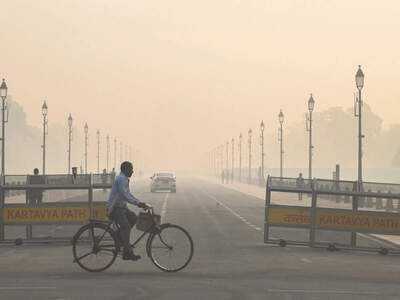
Delhi air pollution: GRAP 3 restrictions kick in ahead of Diwali; what's allowed and what's banned
has been brought under Stage III of the Graded Response Action Plan (GRAP) from Friday as air quality deteriorated to alarming levels, triggering stricter curbs on vehicles, construction activities and other pollution-generating operations across the region.
The Commission for Air Quality Management () invoked the restrictions two days ahead of Diwali in a pre-emptive move to prevent from worsening further and entering the severe category across the capital.
Delhi's overall Air Quality Index (AQI) stood at 382 on Friday, placing it in the 'very poor' category, according to Central Pollution Control Board () data. However, several monitoring stations recorded severe pollution levels, with IIT Delhi and Rohini reporting an AQI of 474 each. Punjabi Bagh recorded 465, RK Puram 443, ITO 422, Firoz Shah Road 420 and India Gate 403.
With GRAP Stage III now in force, restrictions under the first two stages will remain applicable, alongside additional measures targeting vehicular emissions, construction dust and industrial pollution. The emergency measures cover Delhi and adjoining NCR districts in Haryana, Uttar Pradesh and Rajasthan.
What's banned under GRAP 3 in Delhi-NCR?
The restrictions introduce significant curbs on construction, transportation and industrial activities.
While Stage III imposes tighter restrictions, certain activities and services can continue with safeguards.
Stage I applies when AQI is between 201 and 300, categorised as 'poor', while Stage II is triggered at 301-400, or 'very poor'. Stage III is associated with severe pollution, with the framework providing for its invocation based on forecasts of worsening air quality. Stage IV applies when AQI exceeds 450, entering the 'severe plus' category, and brings emergency restrictions, including curbs on heavy goods vehicles.
The latest escalation is intended to prevent Delhi-NCR's air quality from slipping further into the severe-plus category, with children, elderly people and those with respiratory conditions particularly vulnerable to prolonged exposure to polluted air.
(With inputs from ANI)
The Commission for Air Quality Management () invoked the restrictions two days ahead of Diwali in a pre-emptive move to prevent from worsening further and entering the severe category across the capital.
Delhi's overall Air Quality Index (AQI) stood at 382 on Friday, placing it in the 'very poor' category, according to Central Pollution Control Board () data. However, several monitoring stations recorded severe pollution levels, with IIT Delhi and Rohini reporting an AQI of 474 each. Punjabi Bagh recorded 465, RK Puram 443, ITO 422, Firoz Shah Road 420 and India Gate 403.
With GRAP Stage III now in force, restrictions under the first two stages will remain applicable, alongside additional measures targeting vehicular emissions, construction dust and industrial pollution. The emergency measures cover Delhi and adjoining NCR districts in Haryana, Uttar Pradesh and Rajasthan.
What's banned under GRAP 3 in Delhi-NCR?
The restrictions introduce significant curbs on construction, transportation and industrial activities.
- Construction activities: Non-essential construction and demolition work, including major excavation, earthwork and road construction, will be prohibited. Essential projects can continue subject to stringent dust-control measures.
- : BS-III petrol and BS-IV diesel four-wheelers face restrictions in Delhi and designated NCR districts.
- Goods vehicles: Restrictions have been tightened on older light and medium goods vehicles and non-Delhi-registered diesel commercial vehicles entering the capital.
- Industrial operations: Stone crushers and mining activities face shutdowns or operational restrictions to curb dust and particulate emissions.
- Dust-generating activities: Other non-essential operations contributing significantly to dust pollution will also face curbs.
While Stage III imposes tighter restrictions, certain activities and services can continue with safeguards.
- Essential construction: Projects classified as essential are permitted to continue, provided they comply with prescribed dust-mitigation measures.
- Schools: Authorities have the option of shifting classes up to Class 5 to a hybrid learning format, combining physical attendance with online classes.
- Metro services: Additional Metro trips will be introduced to accommodate commuters and discourage the use of private vehicles.
- Public buses: Authorities will deploy additional buses to strengthen public transport and reduce dependence on private vehicles.
Stage I applies when AQI is between 201 and 300, categorised as 'poor', while Stage II is triggered at 301-400, or 'very poor'. Stage III is associated with severe pollution, with the framework providing for its invocation based on forecasts of worsening air quality. Stage IV applies when AQI exceeds 450, entering the 'severe plus' category, and brings emergency restrictions, including curbs on heavy goods vehicles.
The latest escalation is intended to prevent Delhi-NCR's air quality from slipping further into the severe-plus category, with children, elderly people and those with respiratory conditions particularly vulnerable to prolonged exposure to polluted air.
(With inputs from ANI)
Contact to : xlf550402@gmail.com
Copyright © boyuanhulian 2020 - 2023. All Right Reserved.