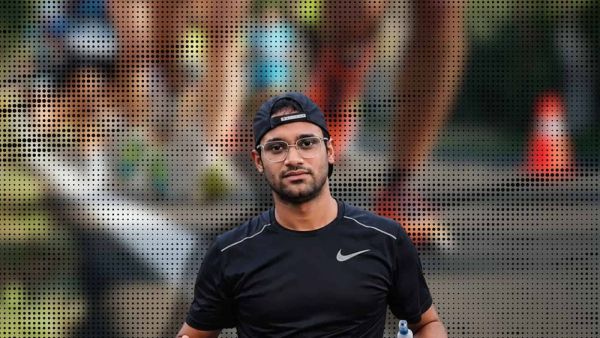
Recently, sports lovers and fitness enthusiasts in Hyderabad were shocked to learn about the untimely death of a 36-year-old man named Komineni Gopi who collapsed minutes after completing the gruelling Hyderabad marathon that ended at the Gachibowli stadium. He had successfully completed the 42.2 km marathon and collected his finisher’s medal. The tragic incident highlighted the dangers of gradual but unfelt coronary artery degeneration even among young and fit persons.
A few minutes after finishing his run, Gopi, while walking towards the breakfast area, suddenly collapsed and fell to the ground. The event organisers immediately performed CPR and rushed him to a nearby private hospital, but he could not be saved. Doctors declared him dead at around 8:45 am. Police investigations suggest that he suffered a massive heart attack.
Sadly, he left behind his wife and a three-year-old child.
On the same day, at the other end of the planet, in New York City, a 24-year-old woman named Rachel Apa too breathed her last while taking part in the marathon there. She collapsed and died barely two miles from the finish line. She was running her first marathon in honour of her late grandfather who had been suffering from Parkinson’s Disease.
According to Rachel’s father Steve, she was in perfect health. Rachel had played hockey for Bucknell University and had trained hard before running the marathon.

Muscles break down due to overexertion
It was diagnosed that she died from rhabdomyolysis, a rare condition where muscles break down and poison the bloodstream, which can be brought on by overexertion. She fell to the ground near mile marker 24. A bystander performed CPR before medical staff arrived and took her to hospital in critical condition. But in the end, the life of this active and healthy young woman could not be saved.
It is important to remember that while taking part in highly stressful physical sports and games, the human body is subjected to very unusual pressures. Every participant should be careful to understand how the human body works and how much he or she is capable of doing instead of blindly following popular theories. Each human body is built differently and functions in a different way under extreme stress.
Cardiac arrest during or after a marathon can affect even healthy young people, sometimes because of previously undetected heart conditions. Medical screening and sensible preparation can reduce risks.
However, it must be emphasised that no screening test can guarantee complete protection.
Pressure created by social media
There is also a larger issue here. Social media has created a culture in which completing a marathon is increasingly seen as a personal achievement to be displayed and celebrated. While there is nothing wrong with ambition, people must not allow competition, peer pressure or the desire for social recognition to dictate their fitness goals.
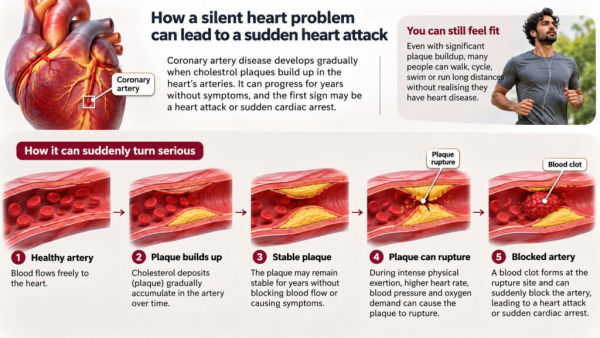
This is largely because fit and active people appear healthy, believe they are doing all things right and may not be rigorous about getting themselves tested. The European Society of Cardiology reports that more than 80 per cent of sudden cardiac deaths in athletes above the age of 35 are attributable to coronary artery disease, or CAD.
How it happens
It develops gradually when cholesterol plaques accumulate within the coronary arteries. The process may continue silently for years, without producing obvious symptoms. A person may walk regularly, cycle, swim or even run long distances without realising that significant coronary disease is developing because his heart can absorb the stress. In such individuals, the first manifestation of coronary artery disease may be a heart attack or sudden cardiac arrest without the familiar warning of chest pain.
There is such a thing called plaque rupture. A cholesterol plaque may remain relatively stable for years without causing obstruction to blood flow.
But, during intense physical exertion, the heart rate, blood pressure and the heart’s demand for oxygen are bound to rise considerably. In some cases, a plaque can rupture. A blood clot is then formed at the site of the rupture. Then, if the blood clot suddenly blocks the coronary artery, it can produce an acute heart attack.
The right attitude to fitness goals
It is important to look at fitness in the right way. Fitness is a lifelong journey. Walking, jogging and running should improve our health and our lives, not put them at risk.
Marathon running should not be taken up due to peer pressure. A beginner who takes a year (or more) to prepare for a marathon, has achieved something far more worthwhile than someone who rushes into it after three or four months.
The old adage that “slow and steady wins the race” is more relevant to marathon running than to any other sporting activity. Even fit young persons must keep that in mind and not do too much too soon.
Contact to : xlf550402@gmail.com
Copyright © boyuanhulian 2020 - 2023. All Right Reserved.