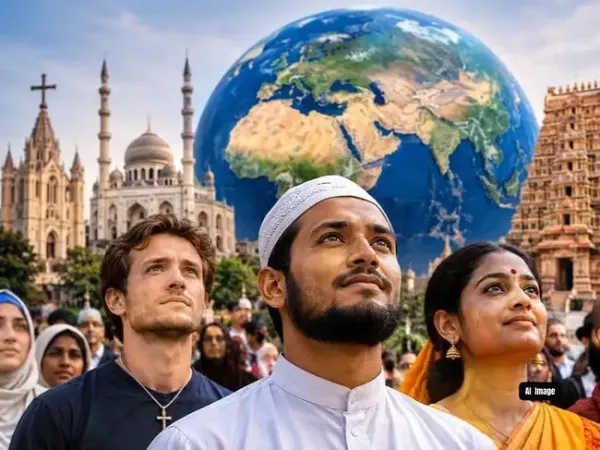
Pew study projects Muslims will become the world's largest religious group by 2035, Pakistan will lead in Muslim population by 2070, and India's Hindu population share will decline.
Muslims are projected to overtake Christians and become the world's largest religious community by 2035, while Pakistan is expected to emerge as the country with the largest Muslim population by 2070, according to new projections by the Pew Research Center. The findings point to significant changes in the world's religious composition over the next five decades, with differences in fertility rates, population age profiles and migration expected to play a major role.
The projections also indicate that India's religious demographics will gradually change. Although the Hindu population in India is expected to increase by 176 million between 2020 and 2070, its share of the country's total population is projected to decline slightly. Muslims are expected to account for a growing proportion of India's population during the same period.
The study examines the projected growth and decline of major religious communities across the world between 2020 and 2070. It considers factors such as birth rates, mortality, international migration and people changing their religious identities.
The difference is expected to become considerably larger over the following decades. If present demographic trends continue, the number of Muslims worldwide could cross 3.6 billion by 2070, while the Christian population is projected to remain below 3 billion. Higher fertility rates are among the biggest reasons behind this shift. Muslim women had an average of 3.1 children during 2020-2025, compared with 2.5 children among Christian women.
Women belonging to other religious communities had an average of 1.6 children, considerably below the replacement fertility level of 2.1. Conrad Hackett, a senior demographer at Pew Research Center, highlighted the importance of birth rates in explaining the changing numbers. "It's the babies," Hackett said, explaining that population growth through births plays a much bigger role than religious conversion in the expansion of the Muslim community.
 Pew estimates that Muslim mothers gave birth to approximately 252 million babies between 2020 and 2025. The corresponding number for Christian mothers was around 208 million. Muslims are also projected to be the only major religious group to experience a continued increase in births over the coming decades. Births among several other religious communities are expected to remain relatively stable or decline.
The changing rankings underline how population growth could reshape the religious composition of several countries, particularly across Asia and Africa.
The country's Hindu population is projected to increase by another 176 million by 2070. Despite this substantial addition, its share of India's population is expected to fall as the Muslim population grows at a relatively faster pace. The difference in fertility rates and the younger age structure of India's Muslim population are expected to contribute to this change.
India's overall fertility rate has declined considerably over the years. However, Muslim women continue to have more children on average than Hindu women, a difference that is expected to influence the country's religious demographics. Importantly, the projections do not suggest that India's Hindu population will shrink in absolute numbers. Rather, the Hindu community is expected to grow while accounting for a somewhat smaller proportion of the country's population.
Hindus are still projected to make up more than three-quarters of India's population in 2070.
However, the world's population is expected to grow at a faster pace, reducing the Hindu share from around 15% in 2020 to 14% in 2070. The Asia-Pacific region will account for the overwhelming majority of this growth. Nearly 99% of the world's Hindus currently live in this region, and its Hindu population is projected to increase by 191 million over the next five decades.
The Hindu population in North America is also expected to more than double, increasing from around 4 million in 2020 to 9 million by 2070. Migration is expected to contribute significantly to Hindu population growth in the United States, Europe and the Middle East.
The rankings of countries with the largest Hindu populations could also change. The United States is projected to enter the top five by 2070, while Australia is expected to join the top 10. Pakistan's Hindu population is projected to double from approximately 5 million in 2020 to 10 million by 2070. Despite the increase, the country is expected to retain its fourth position globally.
Pew's projections suggest that religious conversion will have a relatively limited impact on the overall growth of both Hindu and Muslim populations. Around 99% of people raised as Hindus are estimated to continue identifying with the religion as adults. Muslims have a similar retention rate of 99%.
The corresponding retention rates are 85% for Christians and 83% for Buddhists. Religious switching is projected to reduce the global Hindu population by approximately 1 million between 2020 and 2070. In comparison, natural population growth is expected to add more than 200 million Hindus over the same period. These findings indicate that demographic factors, rather than large-scale changes in religious identity, will largely determine how the world's religious communities evolve.
At the same time, the Muslim share of Europe's population is projected to increase from 6% to 13%. Sub-Saharan Africa, meanwhile, is expected to become increasingly important to the global Christian community. By 2070, more than half of the world's Christians could live in this region.
The Democratic Republic of Congo is projected to overtake the United States as the country with the largest Christian population. Its Christian population could reach 270 million, nearly three times its 2020 level.
Changes are also expected in North America.
Christians currently account for around 62% of the US population. However, their share is projected to fall below 50% by 2065. The number of Christians in the country could decline from approximately 217 million in 2020 to 174 million by 2070. In Canada, Christians are expected to account for less than half the population by 2030. By 2070, people without a religious affiliation could outnumber Christians. The unaffiliated category includes atheists, agnostics and people who do not identify with any organised religion.
Hindus and Jews, meanwhile, are projected to increase in absolute numbers but lose some share of the world's total population. Overall, the world's population is expected to grow by 29% between 2020 and 2070. Muslims and Christians are the only major religious communities projected to grow at or above this pace, with their populations expected to increase by 80% and 30%, respectively.
The findings also highlight the growing importance of understanding relations between different religious communities as their geographical distribution changes. The projections are based on current demographic patterns and assumptions. They are not guaranteed outcomes, as changes in fertility, migration, mortality and religious identification could influence the actual numbers over the coming decades.
(Inputs from ToI, PTI, ANI)
The projections also indicate that India's religious demographics will gradually change. Although the Hindu population in India is expected to increase by 176 million between 2020 and 2070, its share of the country's total population is projected to decline slightly. Muslims are expected to account for a growing proportion of India's population during the same period.
The study examines the projected growth and decline of major religious communities across the world between 2020 and 2070. It considers factors such as birth rates, mortality, international migration and people changing their religious identities.
Muslims to overtake Christians as world's largest religious group by 2035
Christianity is currently the world's largest religion, but the gap between Christians and Muslims is expected to disappear over the next decade. Pew estimates that the world had approximately 2.27 billion Christians and 2.02 billion Muslims in 2020. However, the Muslim population is projected to reach 2.57 billion by 2035, marginally exceeding the estimated 2.52 billion Christians.The difference is expected to become considerably larger over the following decades. If present demographic trends continue, the number of Muslims worldwide could cross 3.6 billion by 2070, while the Christian population is projected to remain below 3 billion. Higher fertility rates are among the biggest reasons behind this shift. Muslim women had an average of 3.1 children during 2020-2025, compared with 2.5 children among Christian women.
Women belonging to other religious communities had an average of 1.6 children, considerably below the replacement fertility level of 2.1. Conrad Hackett, a senior demographer at Pew Research Center, highlighted the importance of birth rates in explaining the changing numbers. "It's the babies," Hackett said, explaining that population growth through births plays a much bigger role than religious conversion in the expansion of the Muslim community.
Pakistan projected to overtake Indonesia as country with most Muslims
One of the most significant changes highlighted by the projections concerns the countries with the largest Muslim populations. Indonesia currently has the world's largest Muslim population. However, Pakistan is expected to take the top position by 2070, followed by India, Nigeria and Indonesia. The change reflects the expected pace of population growth in these countries over the coming decades.The changing rankings underline how population growth could reshape the religious composition of several countries, particularly across Asia and Africa.
Hindu population in India to increase, but its share may decline
India is expected to remain home to the world's largest Hindu population throughout the projection period. However, the community's proportion of the country's total population is projected to decline slightly by 2070. According to Pew, India had approximately 1.1 billion Hindus in 2020, accounting for nearly 95% of the global Hindu population.The country's Hindu population is projected to increase by another 176 million by 2070. Despite this substantial addition, its share of India's population is expected to fall as the Muslim population grows at a relatively faster pace. The difference in fertility rates and the younger age structure of India's Muslim population are expected to contribute to this change.
India's overall fertility rate has declined considerably over the years. However, Muslim women continue to have more children on average than Hindu women, a difference that is expected to influence the country's religious demographics. Importantly, the projections do not suggest that India's Hindu population will shrink in absolute numbers. Rather, the Hindu community is expected to grow while accounting for a somewhat smaller proportion of the country's population.
Hindus are still projected to make up more than three-quarters of India's population in 2070.
Global Hindu population to reach nearly 1.4 billion by 2070
The Hindu population worldwide is also expected to expand over the next five decades, although its share of the global population is projected to decline. Pew estimates that the global Hindu population will increase by approximately 199 million between 2020 and 2070, reaching nearly 1.4 billion.However, the world's population is expected to grow at a faster pace, reducing the Hindu share from around 15% in 2020 to 14% in 2070. The Asia-Pacific region will account for the overwhelming majority of this growth. Nearly 99% of the world's Hindus currently live in this region, and its Hindu population is projected to increase by 191 million over the next five decades.
The Hindu population in North America is also expected to more than double, increasing from around 4 million in 2020 to 9 million by 2070. Migration is expected to contribute significantly to Hindu population growth in the United States, Europe and the Middle East.
The rankings of countries with the largest Hindu populations could also change. The United States is projected to enter the top five by 2070, while Australia is expected to join the top 10. Pakistan's Hindu population is projected to double from approximately 5 million in 2020 to 10 million by 2070. Despite the increase, the country is expected to retain its fourth position globally.
Why are religious demographics changing across the world?
Fertility rates, the average age of religious communities, migration and religious switching are the key factors behind the projected changes. Communities with younger populations generally have a larger proportion of people entering their childbearing years. This can contribute to faster population growth, even when fertility rates gradually decline.Pew's projections suggest that religious conversion will have a relatively limited impact on the overall growth of both Hindu and Muslim populations. Around 99% of people raised as Hindus are estimated to continue identifying with the religion as adults. Muslims have a similar retention rate of 99%.
The corresponding retention rates are 85% for Christians and 83% for Buddhists. Religious switching is projected to reduce the global Hindu population by approximately 1 million between 2020 and 2070. In comparison, natural population growth is expected to add more than 200 million Hindus over the same period. These findings indicate that demographic factors, rather than large-scale changes in religious identity, will largely determine how the world's religious communities evolve.
Christian population to decline in Europe and North America
The projections also highlight a major geographical shift in Christianity's population base. Europe, which has historically been a major centre of Christianity, is expected to experience a substantial decline in its Christian population. The number of Christians in Europe is projected to fall from 505 million in 2020 to approximately 324 million by 2070. The region's overall population is also expected to decline by 17%.At the same time, the Muslim share of Europe's population is projected to increase from 6% to 13%. Sub-Saharan Africa, meanwhile, is expected to become increasingly important to the global Christian community. By 2070, more than half of the world's Christians could live in this region.
The Democratic Republic of Congo is projected to overtake the United States as the country with the largest Christian population. Its Christian population could reach 270 million, nearly three times its 2020 level.
Changes are also expected in North America.
Christians currently account for around 62% of the US population. However, their share is projected to fall below 50% by 2065. The number of Christians in the country could decline from approximately 217 million in 2020 to 174 million by 2070. In Canada, Christians are expected to account for less than half the population by 2030. By 2070, people without a religious affiliation could outnumber Christians. The unaffiliated category includes atheists, agnostics and people who do not identify with any organised religion.
What does the Pew study project for other religions?
While Islam and Christianity are expected to expand, other major religious communities face a different demographic outlook. The Buddhist population is projected to decline both in absolute numbers and as a share of the global population. Expected population declines in China, Japan and South Korea are among the factors contributing to this trend.Hindus and Jews, meanwhile, are projected to increase in absolute numbers but lose some share of the world's total population. Overall, the world's population is expected to grow by 29% between 2020 and 2070. Muslims and Christians are the only major religious communities projected to grow at or above this pace, with their populations expected to increase by 80% and 30%, respectively.
The findings also highlight the growing importance of understanding relations between different religious communities as their geographical distribution changes. The projections are based on current demographic patterns and assumptions. They are not guaranteed outcomes, as changes in fertility, migration, mortality and religious identification could influence the actual numbers over the coming decades.
(Inputs from ToI, PTI, ANI)