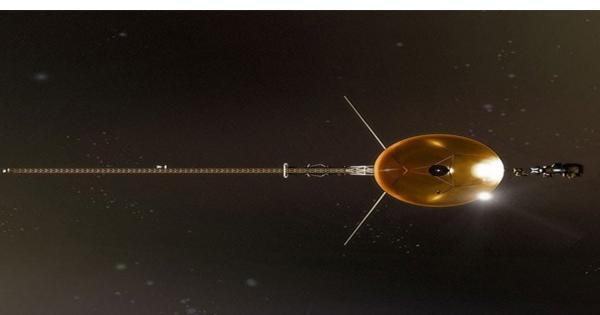
On November 19, NASA’s Voyager-1 spacecraft achieved a historic milestone by reaching a distance from Earth that light takes one day to travel. Launched in 1977, Voyager-1 is now over 26 billion kilometers away from Earth.
This distance is now measured in light-days rather than kilometers. A light-day is the distance that light travels in one day. NASA posted on the social media platform ‘X’ that on November 18, 2026, at 5:16 AM (EST), Voyager-1 reached a distance of one light-day from Earth.
Karim Badaruddin, the Voyager mission manager at NASA’s Jet Propulsion Laboratory in Pasadena, California, stated that this has never happened before and may not happen again in the future. He described it as an extraordinary achievement. Voyager-1 and its twin spacecraft Voyager-2 were originally designed for a five-year mission to study Jupiter and Saturn.
However, both spacecraft have been operational for nearly ten times longer than the expected duration. Both spacecraft are now studying interstellar space. Voyager-1 crossed the vast protective region known as the ‘heliosphere’ created by the Sun’s magnetic field in 2012, while Voyager-2 did so in 2018.
Voyager-1 is traveling through space at a speed of about 61,000 kilometers per hour. Its target is the star Gliese 445, which is more than 17 light-years away from Earth. It is estimated that in about 40,000 years, this spacecraft will pass within approximately 1.7 light-years of this star.
After a journey of 49 years, 2 months, and 11 days, Voyager-1 crossed the historic milestone of one light-day distance on Wednesday. According to NASA, the spacecraft is still in contact with Earth through its ‘Deep Space Network’ and is sending data via four active scientific instruments, including a cosmic ray telescope, low-energy charged particles experiment, magnetometer, and plasma waves experiment.
The Voyager interstellar mission began on January 1, 1990, with the aim of studying the outer boundaries of the Sun’s influence and the space beyond. Mission officials estimate that Voyager-1 can continue to operate for another three to five years.
Publish with Us: Wish to feature your personal or organizational milestones, success stories, or press releases in Tezzbuzz English? Contact us, and we will guide you through our publication process.
Feedback & Corrections: We strive for accuracy. If you spot an error, have feedback, or object to the content of this article/press release, please notify us at loktejoline (at) gmail (dot) com. We will review the matter and rectify it at the earliest.
Contact to : xlf550402@gmail.com
Copyright © boyuanhulian 2020 - 2023. All Right Reserved.