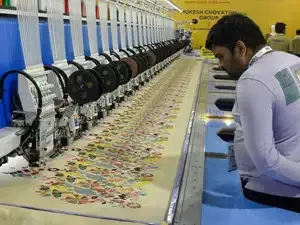
New Delhi [India], November 23 (ANI): India's textiles and apparel industry must grow by more than 10 per cent annually from its current valuation of USD 190-200 billion to reach its target of USD 350 billion by FY31, according to a joint BCG-CII report released at TEXCON '26 in New Delhi.
The study, titled "Winning the Global Wardrobe: India's roadmap to Textile and Apparel leadership", noted that exports face a steeper requirement, needing over 20 per cent annual growth from their stagnant decadal level of USD 37 billion to reach the USD 100 billion ambition.
The report stated that the sector employs over 45 million people, with women accounting for half of the workforce, and contributes 13 per cent to industrial output. While India serves as the world's second-largest textile exporter with a 6 per cent global share, its presence in finished apparel stands at roughly 3 per cent. Capturing an additional 2 to 3 percentage points in global apparel exports can unlock USD 10-15 billion as China cedes market share.
"India's textiles and apparel industry supports over 45 million people, making it an important source of livelihoods across the country. As the sector works towards its ambition of reaching USD 350 billion by FY31, with USD 100 billion in exports, strengthening manufacturing capabilities will be essential," said Kulin Lalbhai, Chairman of the CII National Committee on Textiles & Apparel and Vice Chairman of Arvind Ltd.
"Garmenting alone generates approximately 30 jobs for every Rs 1 crore invested, highlighting the opportunity to drive both economic growth and employment. Closer collaboration between industry and government can help translate this latent potential into meaningful outcomes," Lalbhai added.
Ministry of Textiles Secretary Neelam Shami Rao emphasized the urgency of domestic fibre availability and long-term buyer ties. "With per-capita fibre consumption expected to increase from around 5 kg to 10-15 kg over the next 20 years, India's fibre production will need to grow from its current 14-15 million metric tonnes to 22-26 million metric tonnes over the next eight years," Rao said.
"The current global realignment of sourcing presents an important window for India, but it is not one that will remain open indefinitely. It is therefore essential that Indian businesses move beyond transactional trade and build enduring commercial relationships based on mutual interests and collaboration," she added.
The BCG-CII report identified productivity gaps and fragmented capacities as core challenges. Competing nations like Bangladesh deliver roughly 20 percentage points higher labour productivity and operate factories with 1.5 times greater automation. Furthermore, India holds less than 1 per cent share in global synthetic outerwear and sportswear trade, despite synthetic fibres dominating over 70 per cent of those segments.
"There is opportunity to create integrated clusters from spinning to garmenting and increase the share of such clusters in manufacturing from today's 5-6%. Also, there is opportunity to target and increase share in key synthetic-led categories such as knitwear, outerwear and sportswear from today's 1%," Nishant Shekhar, Managing Director and Partner at BCG, said.
BCG Partner Arpit Agarwal noted that free trade agreements with the EU and UK, which represent USD 140 billion of global apparel trade, can narrow India's 10 to 12 percentage point tariff gap, provided suppliers become reliable anchor partners.
Meanwhile, BCG Managing Director Mehak Dhir pointed out that artificial intelligence and automation across the value chain can deliver over 20 per cent higher manufacturing productivity and cut defect rates by more than 20 per cent.